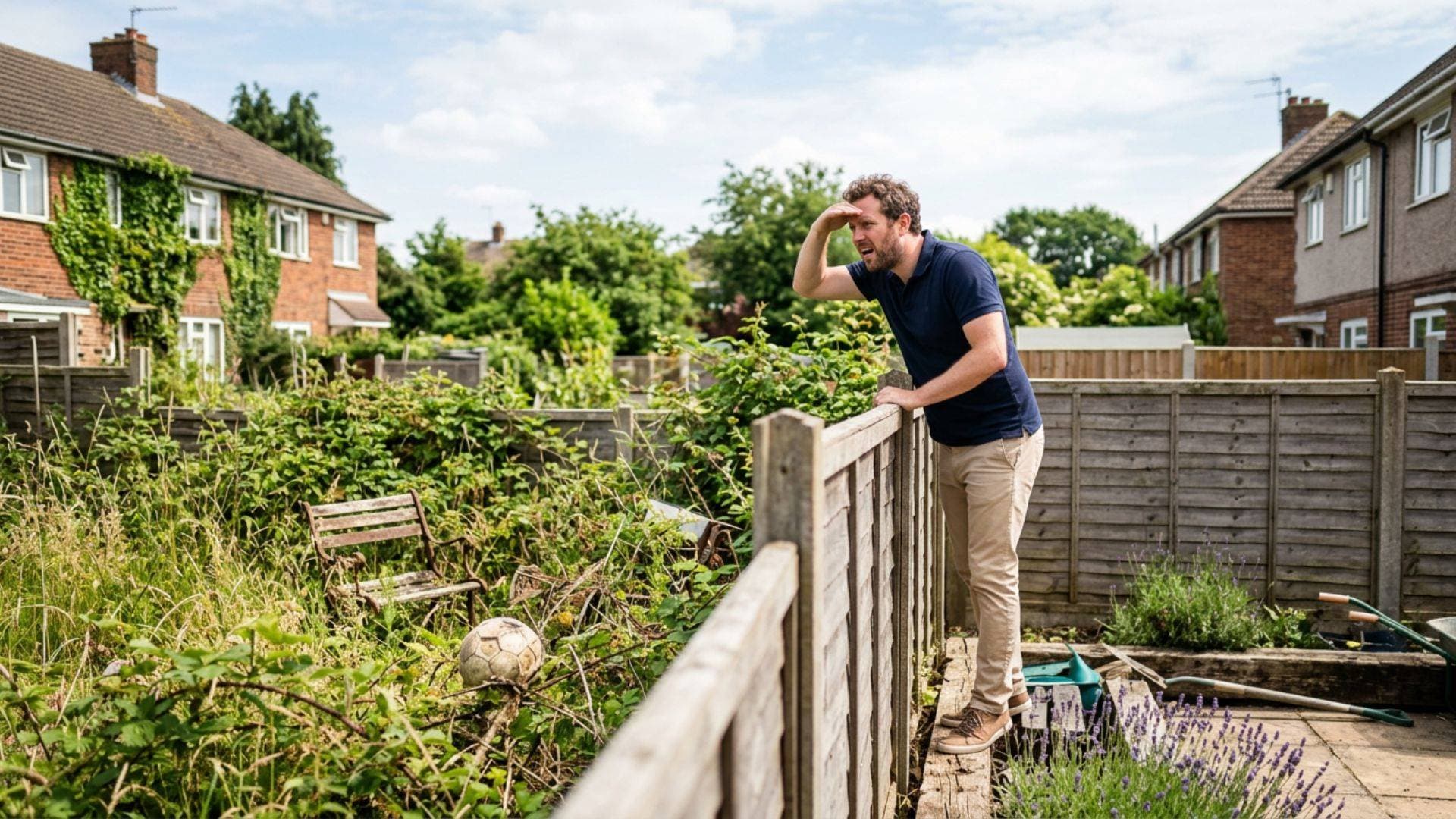
The price is within budget. It has the right number of bedrooms. The location is perfect. But there’s an issue. The people next door have let their rear garden go wild.
Not everyone has green fingers but it’s an unspoken rule that we keep our outside spaces under control. So, is it worth taking a risk and offering on a property where the adjacent garden resembles a jungle?
Many buyers ask us if anything can be done before they make an offer. It’s up to the seller and their neighbour to agree how a garden should be tamed but there is one specific, plant-related task that’s part of the conveyancing process: Japanese Knotweed.
Japanese Knotweed: spreading like wildfire
Japanese Knotweed spreads aggressively and garden fences won’t stop it travelling from one property to another. Its roots damage patios, brickwork and concrete, weakening structures as it travels.
There’s a specific question about Japanese Knotweed on the TA6 Property Information Form. The seller’s answer determines what happens next.
The seller may answer ‘yes’ on the TA6 form and disclose the presence of Japanese Knotweed. In this case, the buyer can request the seller get this professionally treated before they proceed. Or they can ask the seller to reduce the price to reflect the issue but be aware: a mortgage lender may refuse an application if there’s known Japanese Knotweed at a property.
If the seller answers ‘no’ to the Japanese Knotweed question but you suspect the plant is next door – perhaps you spot it on a viewing - it’s advisable to commission a specialist survey that will identify the risk. The seller, however, doesn’t have to give a specialist access to their garden.
Commonly, the seller will answer ‘not known’ and this pushes the responsibility back on the buyer to investigate, especially if the threat is from a neighbouring garden.
Buyer beware regarding bamboo
You might wonder if the same is true of bamboo. While there’s no specific bamboo question on the TA6 form, a mortgage lender can withhold funds if it shows up in a survey. The ‘running’ type of bamboo spreads rapidly from property to property and a buyer who has seen bamboo next door should involve a specialist.
Issues after exchange
The buyer can sue the seller if they feel they lied on the TA6 form, as this constitutes misrepresentation. The difficulty will be proving whether an invasive species was in the garden at the time of sale, or whether it spread from a neighbour’s garden after exchange.
Forcing neighbours to take responsibility
If an invasive species spreads from next door and causes damage after you have moved in, you have protection. You can try and resolve the matter amicably but you may need to use a mediation service or take legal action. Under the law of private nuisance, neighbours are liable for damage to an adjacent property if they fail to stop an invasive species spreading.
Trim carefully to avoid trouble
More commonly, the ‘jungle’ aspect of any overgrown garden is trees and shrubs that have got out of control. Trimming and pruning anything that’s hanging over the fence is a hot topic. You must not step onto your neighbour’s land to undertake any gardening but the Government offers clarification on what you can do:
“You can trim branches or roots that cross into your property from a neighbour’s property or a public road. You can only trim up to the property boundary. If you do more than this, your neighbour could take you to court for damaging their property.”
Before you break out the chainsaw, it’s essential to establish with your local council if any overhanging tree is covered by a tree preservation order or if you live in a conservation area.
Hedge your bets
There is also Government guidance on hedges, which can damage fences and block out light. Neighbours should use the ‘Over the Garden Hedge’ guide to try and peacefully resolve hedge issues. If unsuccessful, the high hedges aspect of the Anti-social Behaviour Act 2003 gives you the right to complain to a local authority if a high hedge is:
-
2 or more mostly evergreen or semi-evergreen trees or shrubs over 2 metres tall
-
affecting your enjoyment of your home or garden because it’s too tall
-
growing on land owned or occupied by someone else
-
a barrier to light or access (even if there are gaps)
The above legislation may also cover trees on your neighbour’s land.
Let there be light, by law
If your concern is about neighbouring trees or fences blocking natural light you receive, you could pursue a complaint under The Right to Light Act 1959. Be prepared, however, to prove if the property has received daylight for the last 20 years – something that can be difficult if the obstacle is a slow-growing tree.
When neighbours have no choice
Buyers should bear in mind that a neighbour’s property could have a restrictive covenant that prohibits them from removing trees or altering the landscape. There is a way of finding out whether a neighbouring property will remain a jungle due to legal restrictions.
As long as the neighbouring land is registered, your solicitor can review all restrictive covenants attached to an adjacent property by obtaining the Title Register and Title Plan from HM Land Registry.
If you’re a potential seller living next door to an overgrown garden, feel free to contact us for advice.
Share this article
More Articles


Sign up for our newsletter
Subscribe to receive the latest property market information to your inbox, full of market knowledge and tips for your home.
You may unsubscribe at any time. See our Privacy Policy.